
[ Archive ]

|
CIMSS-NOAA Weekly Report [ Archive ] |
|
CIMSS-NOAA WEEKLY HIGHLIGHTS FOR THE WEEK ENDING APRIL 3, 2026
DATA, INFORMATION, AND USE-INSPIRED SCIENCE:
PEOPLE, AWARDS AND RECOGNITION:
TRAVEL AND MEETINGS:
CIMSS scientists participate in GSICS annual meeting: The Global Space-based InterCalibration System (GSICS) Annual and Executive Panel meetings were held the week of 23 March at the National Research Council Canada in Ottawa. CIMSS scientists Joe Taylor and David Tobin participated in the Infrared Working Group meetings and presented materials relevant to the Cross-track Infrared Sounder (CrIS), one of the GSICS reference sensors. Materials from the meeting are available at https://gsicsweb.eumetsat.int. (D. Tobin, CIMSS, 608-265-6281)
TRAINING AND EDUCATION:
CIMSS Researchers Train Arctic Forecasters: Cooperative Institute for Meteorological Satellite Studies (CIMSS) Scientists Tim Wagner and William Straka traveled north to participate in the 2026 Arctic Meteorology and Oceanography (METOC) Partnership Summit (AMPS) at the University of Alaska–Fairbanks. This meeting unites academics and civilian forecasters with their military counterparts to help better understand the challenges of forecasting in this unique part of the world. A key component of this meeting was a training session on the operational use of Joint Polar Satellite System data and products organized between CIMSS, the Cooperative Institute for Research in the Atmosphere (CIRA), and the Geographical Information Network of Alaska (GINA). Polar-orbiting satellite products are of particular interest to arctic forecasters due to their relatively frequent refresh rate at high latitudes and the coarse spatial resolution of geostationary satellites in those regions. The training featured presentations and hands-on interaction with various products including the Visible Infrared Imaging Radiometer Suite (VIIRS), the NOAA Unique Combined Atmospheric Processing System (NUCAPS) vertical profiles, and the Advanced Microwave Technology Sounder (ATMS). Interest in the training was so significant that a second section had to be added to accommodate demand. During this visit, the team also met with the Fairbanks National Weather Service Weather Forecast Office to discuss their unique needs and how satellites can assist them in forecasting a large and otherwise sparsely observed region. (T. Wagner, CIMSS, 608-890-1980; W. Straka III, CIMSS)
 (Click image to enlarge)
Figure: CIMSS Scientist Tim Wagner explains the advantages of low-earth orbiting (LEO) satellites to a room of forecasters during the satellite training session. Photo by Bryan Whitten, University of Alaska–Fairbanks.
MEDIA INTERACTIONS AND REQUESTS:
SOCIAL MEDIA AND BLOG Posts:
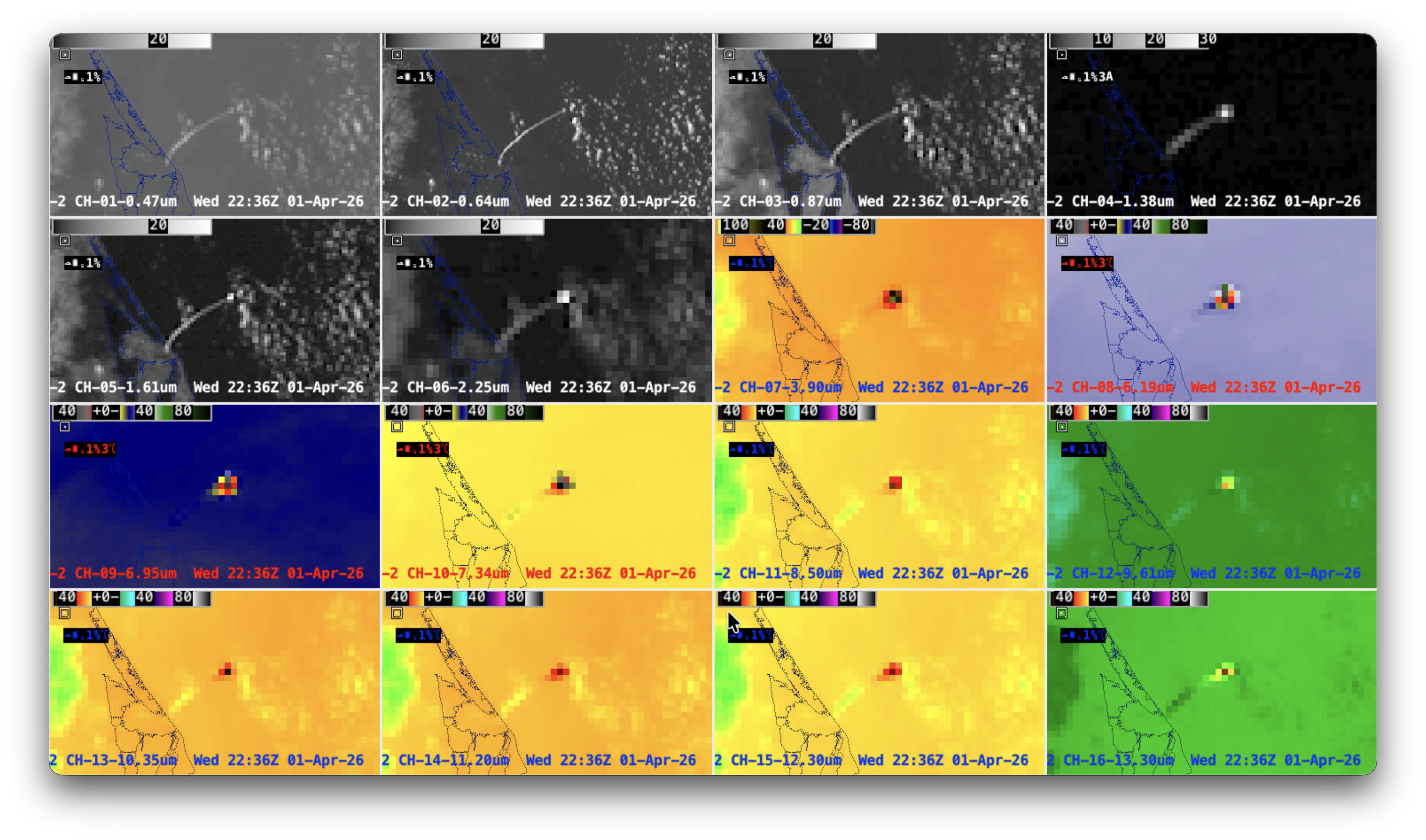
CIMSS Satellite Blog Updates: The Cooperative Institute for Meteorological Satellite Studies (CIMSS) Satellite Blog (https://cimss.ssec.wisc.edu/satellite-blog/) was updated with the following posts: "Strong Storms Form Near the Samoan Islands" (Mar. 28), "Vertically-propagating standing wave clouds downwind of the Coteau des Prairies in South Dakota" (Mar. 28), "Satellite signatures of the Artemis II launch" (Apr. 1) and "Welcome to Space, Artemis II!" (Apr. 2). (S. Bachmeier, T. Wagner, CIMSS, 608-890-1980)
 (Click image to enlarge)
Figure: Multi-panel GOES-19 image at 2236 UTC on April 1, 2026 -- showing that a signature of the NASA Space Launch System rocket booster was evident in all 16 ABI spectral bands during the launch of the Artemis II mission to the Moon.
 (Click image to enlarge)
Figure: Himawari-9 Infrared image at 2140 UTC on March 27, 2026 -- showing widespread deep convection just north of the Samoan Islands.
PUBLICATIONS:
OTHER:
| Archived Weeklies Page | Submit a report item |